Expat Life in Greece in 2026: A Practical Guide to Settling In
Expat life in Greece can offer a rewarding mix of Mediterranean culture, European connectivity, coastal living and diverse choices for work, retirement, family relocation or investment. Yet establishing yourself in the country requires more than finding the right apartment or choosing a favourite island.New residents need to think carefully about immigration status, tax registration, healthcare, accommodation, employment rights, transportation and everyday administration. Planning these areas in advance can make the move far more manageable.This guide explains the main practical issues foreigners should consider when settling in Greece in 2026.
What Makes Greece Attractive to Expats?
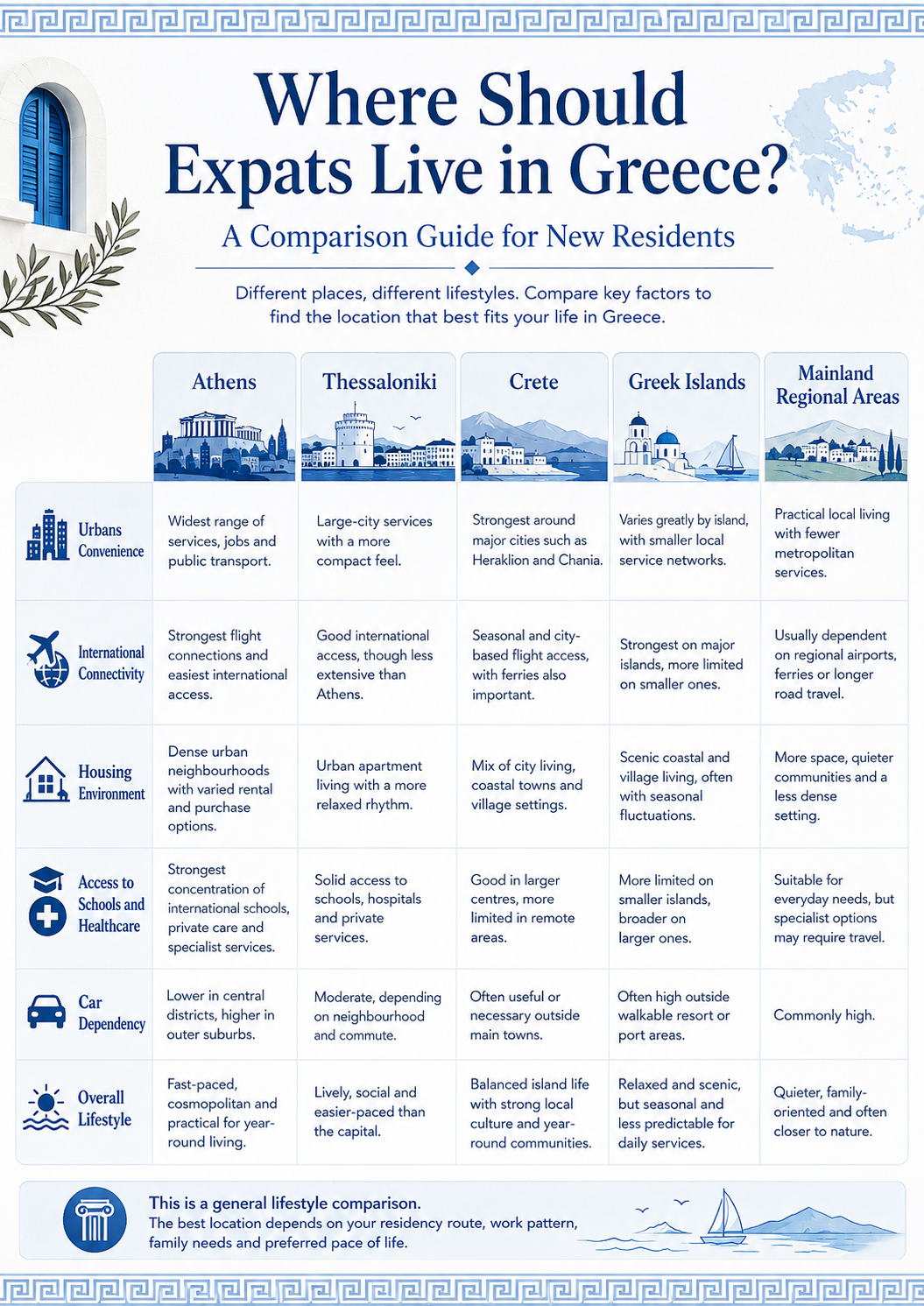
Greece offers a wide variety of living environments.Athens suits residents who want extensive professional services, international schools, major hospitals and direct international travel connections. Thessaloniki provides another major urban option with a more compact city environment.Crete combines sizeable towns with coastal and rural communities, while mainland areas such as the Peloponnese appeal to people who want more space and a quieter pace of life.The Greek islands can also be attractive, particularly for retirees and internationally mobile residents, although permanent island living requires additional planning.When comparing locations, consider:
- Healthcare availability
- International and local schools
- Public transport
- Access to airports
- Ferry connections
- Employment opportunities
- Housing supply
- Year-round shops and services
- Distance from government offices
- Whether a car will be necessary
A place that feels ideal during a short summer stay may function very differently during the quieter winter months.
Start With Your Greek Residence Status
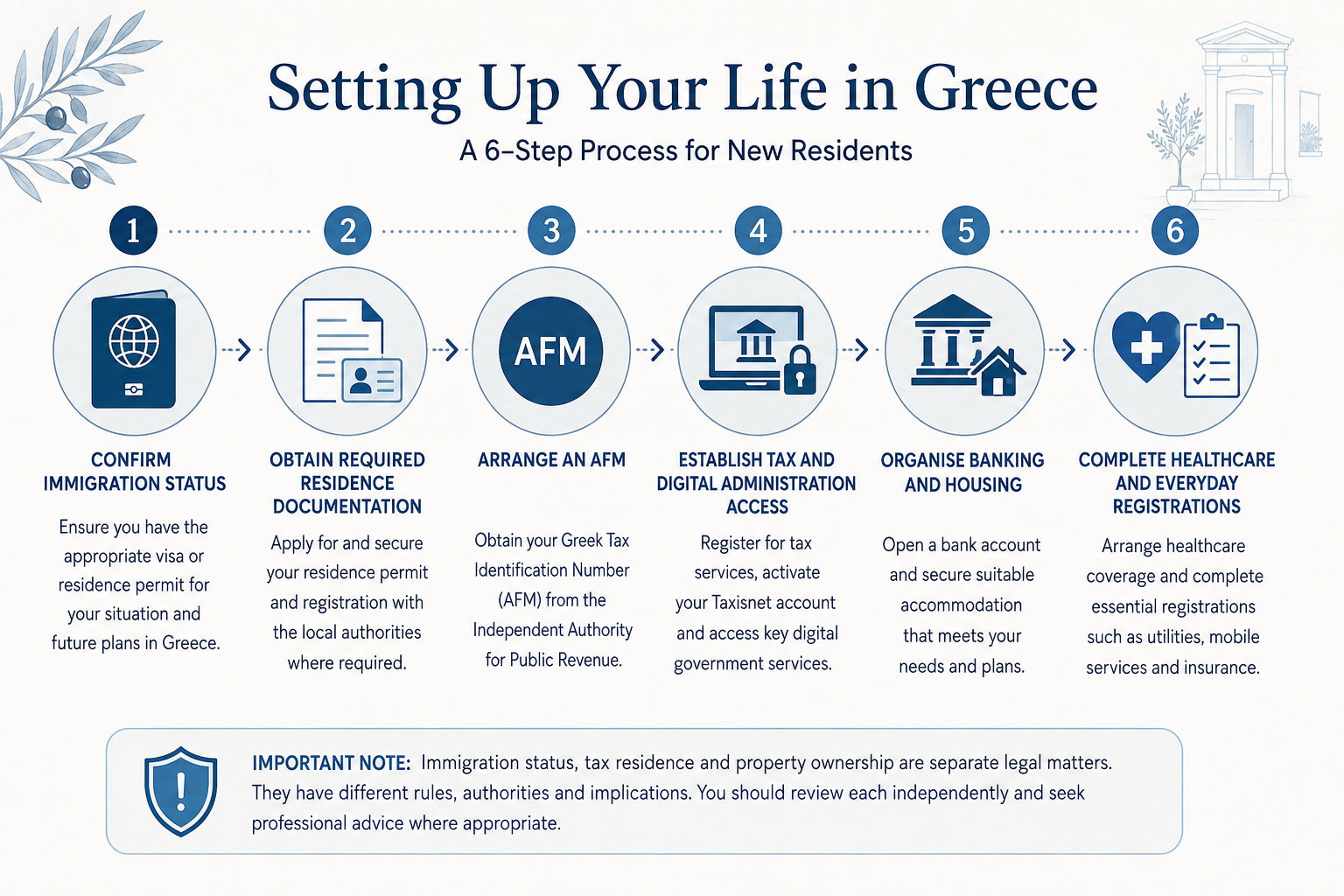
Before arranging property, banking or long-term accommodation, determine which immigration rules apply to you.EU and EEA nationals benefit from European free-movement rights, although administrative registration may still be required when remaining in Greece for longer periods.Non-EU nationals generally need an appropriate visa or residence permit based on the reason for their stay.Different Greek residence categories can apply to:
- Employment
- Family reunification
- Professional or business activity
- Financially independent residents
- Investment
- Other qualifying circumstances
The Greek Ministry of Migration and Asylum provides official information about residence-permit categories and required documentation.International investors may also explore the greece golden visa when considering qualifying investment as a route to residence.Confirm eligibility before signing major contracts or transferring significant funds.
Immigration Residence and Tax Residence Should Be Reviewed Separately
One important distinction for new residents is the difference between immigration residence and tax residence.A residence permit concerns your legal right to live in Greece.Tax residence concerns where you may be required to declare income and meet taxation obligations.The two can interact, but they are not automatically identical.Tax residence can be influenced by factors such as:
- Time spent in Greece
- Permanent residence
- Habitual abode
- Family connections
- Business interests
- Centre of economic and personal interests
For internationally mobile individuals, tax planning should ideally take place before relocation rather than after obligations arise.
Getting an AFM in Greece
An AFM is the Greek Tax Identification Number.Many foreigners need one when establishing financial, employment, business or property-related connections with Greece.An AFM may be necessary for activities such as:
- Purchasing property
- Filing Greek taxes
- Employment administration
- Business registration
- Certain banking procedures
- Entering into contracts
- Managing other financial matters
Foreign residents can review the official AFM application service on gov.gr.Once registered, you may also need access to Greek digital tax services for future administrative procedures.Arranging your AFM early can make later relocation tasks easier.
Renting a Property When You First Arrive
Renting can be useful even if you eventually intend to buy.Spending several months in an area gives you a more accurate understanding of what everyday life actually involves.Consider testing:
- Traffic
- Parking
- Local supermarkets
- Public transport
- Noise levels
- Heating during winter
- Cooling during summer
- Internet availability
- Travel time to work
- Access to hospitals
- School commute times
Renting first can help prevent an expensive property decision based only on a short visit.
Buying Property in Greece
Foreigners considering property ownership should conduct detailed legal and technical due diligence.A property purchase may involve checks relating to:
- Ownership
- Title documentation
- Cadastre or Land Registry records
- Building permits
- Planning compliance
- Legal modifications
- Outstanding obligations
- Property taxes
- Common building expenses
- Renovation requirements
If property is also being purchased as part of a residence-by-investment strategy, immigration eligibility must be checked separately.Not every property suitable for an ordinary purchase necessarily qualifies for a specific investment residence route.Investors looking at eligible opportunities can research greece golden visa properties for sale while comparing their options.
Building an Accurate Cost-of-Living Budget
The cost of living in Greece depends significantly on where and how you live.Central Athens can have very different expenses from a small mainland town. Premium coastal locations and highly visited islands may also carry higher housing and seasonal costs.Your household circumstances are equally important.Consider budgeting for:
- Rent or mortgage
- Electricity
- Water
- Heating
- Air conditioning
- Internet
- Mobile services
- Groceries
- Public transport
- Vehicle costs
- Healthcare
- Insurance
- Education
- Property maintenance
- Accounting
- Legal services
- Leisure
- International travel
A family with children attending an international school will naturally have a different budget from a couple working remotely or a retiree living in a regional town.National averages are therefore less useful than a budget based on your chosen location and lifestyle.
Understanding Tax Residence in Greece
Tax residence deserves careful attention before you establish a permanent base.Greek rules can consider factors such as permanent residence, habitual abode, centre of vital interests and physical presence.The widely referenced 183-day threshold can also be relevant, depending on individual circumstances.The Independent Authority for Public Revenue publishes official information for residents and non-residents.Before relocating, review possible tax treatment of:
- Salary income
- Business earnings
- Rental income
- Investment income
- Pensions
- Overseas property
- Existing companies
- Foreign assets
Double-taxation agreements may also influence the final position.People with assets or income in several countries should consider obtaining individual cross-border tax advice.
Healthcare Options for New Residents
Greece provides both public and private healthcare.Access to public healthcare can depend on factors such as:
- Residence status
- Employment
- Social-security participation
- Nationality
- Individual circumstances
EU citizens should also recognise that healthcare arrangements designed for temporary travel may not be suitable for permanent relocation.The European Union provides official information on health insurance when living abroad.Before moving, check:
- Current insurance coverage
- Public healthcare eligibility
- Private insurance options
- Family coverage
- Prescription medication
- Specialist requirements
- Emergency care
- Distance to major hospitals
Healthcare access is particularly important when comparing large cities with smaller islands or rural communities.
Employment Rights for Expats
Your right to work depends on nationality and residence status.EU nationals generally benefit from European free-movement rules relating to employment.Non-EU nationals should confirm whether their specific visa or residence permit allows the employment or professional activity they intend to undertake.This is particularly important for residence routes based primarily on investment, financial resources or other non-employment grounds.A right to reside should not automatically be interpreted as unrestricted permission to work.
Setting Up a Business in Greece
Entrepreneurs may need to manage additional legal and financial requirements.Depending on the business activity, these may include:
- Company registration
- Selecting a legal structure
- Tax registration
- VAT
- Accounting
- Social-security obligations
- Payroll
- Corporate taxation
- Personal tax implications
Business activity can affect both immigration and taxation, making advance planning especially important.
Education for International Families
Families relocating with children should research schooling before choosing a permanent neighbourhood.Available options may include:
- Greek public schools
- Greek private schools
- International schools
- Foreign-language institutions
Athens has the greatest concentration of international education, while Thessaloniki and certain other locations provide additional options.Before enrolling, compare:
- Curriculum
- Teaching language
- Tuition
- Admission deadlines
- Waiting lists
- Transportation
- Distance from home
- University pathways
School location can significantly influence which part of a city is practical for a family.
Is Greek Necessary for Everyday Life?
Many foreigners can manage day-to-day activities in English, especially in major cities and tourism-focused locations.However, speaking some Greek can make life noticeably easier.Basic Greek can help when dealing with:
- Neighbours
- Small businesses
- Tradespeople
- Healthcare providers
- Building managers
- Public administration
- Rural communities
Language skills also make it easier to integrate socially and understand local life beyond the expat community.
Public Transport and Car Ownership
Transportation requirements vary considerably throughout Greece.Athens offers metro, tram, bus and suburban rail connections, which can make car ownership optional for residents in well-connected areas.Outside the capital, a vehicle may become more useful.Car ownership can be particularly practical in:
- Suburban areas
- Smaller towns
- Rural communities
- Mainland regions
- Some islands
When comparing properties, calculate realistic travel times to places you will use frequently.These may include:
- Workplace
- School
- Hospital
- Supermarket
- Airport
- Ferry port
- Government services
For frequent travellers, easy airport access may be worth prioritising.
Choosing Where to Live in Greece
Athens
Athens is often the most practical choice for professionals and families requiring international schools, major healthcare facilities, employment and frequent international flights.Different districts range from central urban neighbourhoods to coastal and suburban areas.
Thessaloniki
Thessaloniki offers a major-city environment in a more compact setting.It can suit professionals, students, families and residents who prefer northern Greece.
Crete
Crete combines established cities with smaller towns, villages and coastal areas.Its airports, year-round communities and broad range of services can make it practical for permanent island living.
Greek Islands
Smaller islands can offer attractive surroundings and a slower pace.However, residents should carefully investigate winter transport, hospitals, shopping and other year-round services.
Mainland Greece
Mainland regions can offer quieter communities, countryside and more space.They may be particularly suitable for retirees or residents who do not depend on daily access to a major urban centre.
Practical Administration After Arrival
Once you have established your residence and accommodation, everyday setup begins.Common tasks can include:
- Banking
- Electricity contracts
- Water services
- Internet installation
- Mobile phone services
- Insurance
- Tax-system access
- Healthcare registration
- Building-management arrangements
Maintaining organised records will make these procedures easier.Keep copies of important documents such as:
- Passport
- Visa or residence permit
- AFM
- Rental agreement
- Property documents
- Insurance policies
- Banking information
- Tax records
Both secure digital copies and physical originals can be useful.
Mistakes New Expats Should Avoid
Several relocation problems can be prevented with better preparation.Common mistakes include:
- Buying property before understanding the area
- Assuming property ownership automatically grants residence
- Ignoring tax-residence implications
- Choosing a home before confirming schools
- Failing to investigate healthcare
- Assuming all residence permits allow employment
- Underestimating utility and professional costs
- Evaluating an island only during summer
- Relying entirely on English
- Leaving administration until the last moment
Handling the legal and practical issues first can make the lifestyle side of relocation much more enjoyable.
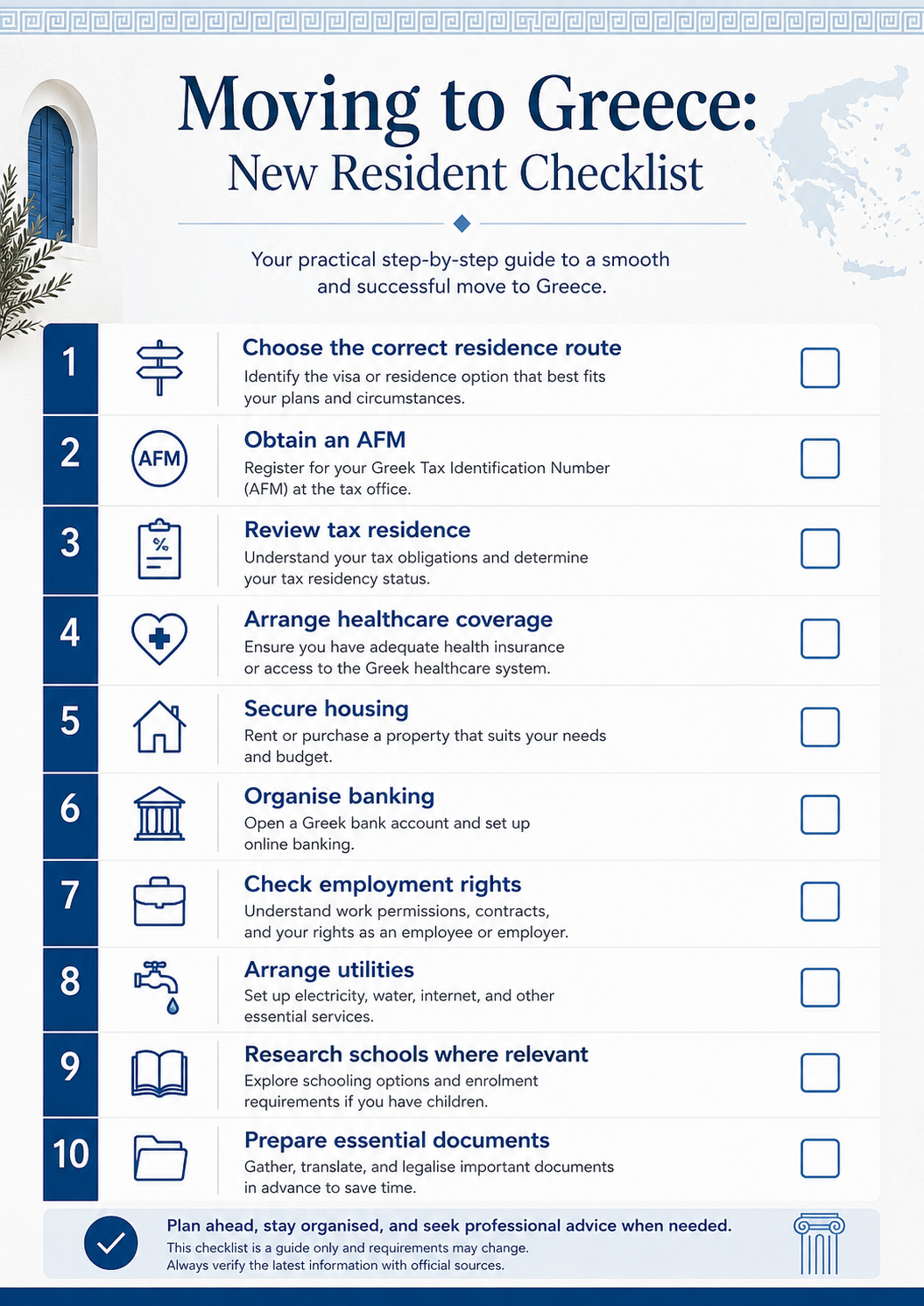
New Resident Checklist for Greece
Before or shortly after relocating, consider completing the following steps:
- Confirm your residence route.
- Check visa and entry requirements.
- Prepare required immigration documentation.
- Obtain an AFM where necessary.
- Review your potential tax residence.
- Arrange healthcare and insurance.
- Compare several locations.
- Decide whether to rent before buying.
- Complete legal and technical property checks.
- Organise banking.
- Confirm employment rights.
- Review business requirements where relevant.
- Research schools.
- Arrange utilities.
- Plan transportation.
- Prepare a realistic household budget.
- Organise important documents.
- Begin learning basic Greek.
Working through these steps systematically can make your first year in Greece considerably easier.
Is Greece a Good Long-Term Home for Expats?
Greece can offer an appealing lifestyle for residents who value Mediterranean living, European access, cultural heritage and a broad choice of urban, coastal and rural environments.Whether it is the right destination depends on your own circumstances.A family may value proximity to international schools in Athens. An entrepreneur may prioritise business infrastructure. A retiree may prefer Crete or a smaller mainland community. An investor may place property and residence planning at the centre of the decision.The strongest approach is to establish your immigration, tax, financial and healthcare position first.Once those foundations are clear, choosing where and how to live in Greece becomes much easier.
Frequently Asked Questions
Can foreigners live long term in Greece?
Yes. The route depends on nationality and circumstances. EU citizens benefit from European free-movement rights, while third-country nationals generally require an appropriate residence permit.
What should expats organise before moving to Greece?
Important early steps include confirming immigration status, reviewing taxation, arranging healthcare, finding accommodation and obtaining necessary administrative registrations.
What is an AFM in Greece?
The AFM is Greece's Tax Identification Number and is used for taxation as well as many property, employment, financial and administrative transactions.
Can spending more than 183 days in Greece affect my taxes?
Yes. Physical presence can be relevant to tax residence, although other factors such as permanent residence and centre of vital interests can also matter.
Can foreign residents buy Greek property?
Foreign nationals can generally purchase property subject to applicable requirements. Legal and technical due diligence should be completed before the transaction.
Can foreigners use public healthcare in Greece?
Eligibility depends on factors including residence status, employment and social-security coverage. Private healthcare and insurance are also available.
Do I need Greek to live in Greece?
Fluent Greek is not essential in many international or urban settings, but learning basic Greek can make administration, healthcare and daily communication significantly easier.
Which Greek city is best for expats?
Athens generally offers the widest range of services and international connections, while Thessaloniki, Crete and other regional locations may suit people with different lifestyle priorities.
