Greece Tourist Visa or Golden Visa? Understanding the Difference
The Greece Tourist Visa vs Investment Visa comparison is less about choosing between two similar visas and more about deciding between two completely different immigration purposes.A tourist visa is designed for short visits. The Greece Golden Visa, often described as an investment visa, is designed for qualifying non-EU nationals who want residence rights through an eligible investment.If you are planning a holiday, visiting relatives, or making a short business trip, the tourist route may be all you need. If you are considering property investment and want renewable residence in Greece, the Golden Visa is the more relevant option.
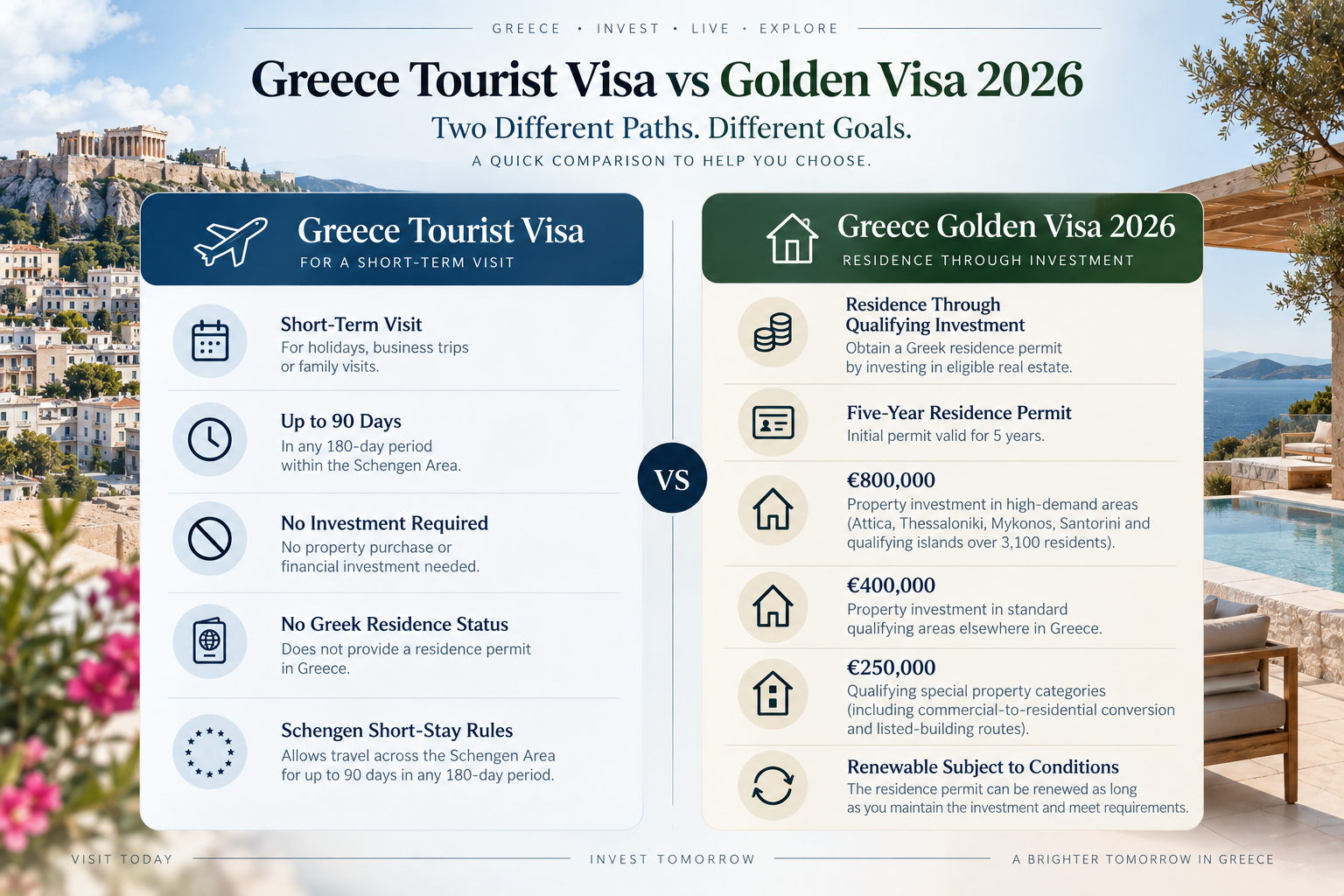
Greece Tourist Visa vs Investment Visa: Quick Overview
| Category | Greece Tourist Visa | Greece Golden Visa |
|---|---|---|
| Main purpose | Temporary travel | Residence through qualifying investment |
| Status granted | Short-stay visa | Greek residence permit |
| Typical duration | Up to 90 days in any 180-day period | Five-year residence permit |
| Investment required | No | Yes |
| Residence rights | No long-term residence | Yes |
| Property ownership required | No | Property is one qualifying route |
| Renewal | Depends on visa conditions | Renewable if program conditions remain satisfied |
| Schengen travel | Subject to visitor limits | Short visits to other Schengen states under applicable rules |
| Employment | Tourist visa does not authorize employment | Investor permit itself does not provide employment access |
The European Commission's Schengen visa guidance states that a short-stay Schengen visa generally covers stays of no more than 90 days in any 180-day period.The Golden Visa, by contrast, places the qualifying applicant in a residence category rather than a short-term visitor category.
How a Greece Tourist Visa Works
A tourist visa for Greece normally falls under the Schengen short-stay visa system.It is commonly used by travelers coming to Greece for:
- Tourism
- Family visits
- Short business activities
- Conferences
- Cultural events
- Other temporary travel purposes
The visa does not create a right to remain in Greece indefinitely.Instead, the traveler must follow the duration and validity stated on the visa and remain within the applicable Schengen limits.For many travelers, this makes the tourist visa perfectly adequate. Someone who visits Greece for a short summer holiday every year does not necessarily need a residence permit simply because they return regularly.The important point is that visitor status remains temporary.
How the Greece Golden Visa Is Different
The Golden Visa serves a different objective.It allows eligible third-country nationals to obtain a Greek residence permit after completing a qualifying investment and satisfying the applicable immigration requirements.The phrase "investment visa" is commonly used in everyday discussion, but the outcome is more accurately described as residence through investment.Anyone researching this option can explore the current Greece Golden Visa program and assess which investment route best matches their plans.For many applicants, real estate is the most familiar pathway.However, Golden Visa property eligibility now depends on more than simply buying a home at a certain price.
Current Greece Golden Visa Property Thresholds
The real estate investment requirement varies depending on location and the legal category of the property.Current routes can include:
- €800,000 in certain high-demand areas
- €400,000 in other qualifying areas
- €250,000 for specific qualifying property categories
The €800,000 level applies to locations including Attica, Thessaloniki, Mykonos, Santorini, and certain islands with populations above 3,100.The Greek government's official Golden Visa property guidance explains the higher €800,000 and €400,000 thresholds.The €250,000 route remains relevant to particular categories that meet additional legal requirements, such as certain commercial-to-residential conversions and qualifying listed-building investments.This means an investor should never assume that a property qualifies just because its price exceeds €250,000.Eligibility must be confirmed according to the applicable route.

Visiting Greece Is Different From Residing in Greece
This is the central distinction between the tourist visa and Golden Visa.A tourist visa allows you to visit.The Golden Visa allows an eligible investor to hold residence status.For a traveler, the difference may not matter very much. If you spend ten days in Athens and another week on a Greek island each year, the tourist route may be sufficient.For someone planning to buy qualifying real estate, maintain a longer-term connection with Greece, or establish a European residence strategy, the distinction becomes much more important.Residence status provides a different legal foundation from repeated temporary visits.
How Long Can You Stay With a Greece Tourist Visa?
The standard short-stay rule is up to 90 days within any 180-day period across the Schengen Area.Those 90 days are not calculated separately for every Schengen country.Time spent in countries such as France, Italy, Spain, or Greece can all count toward the same overall allowance.The European Commission provides an official Schengen short-stay calculator for travelers checking how many days they have used.Individual visa conditions can still be more restrictive, so travelers should always check the dates and permitted duration printed on their visa.
How Long Is the Greece Golden Visa Valid?
A qualifying investor residence permit can generally be issued for five years.It can then be renewed if the investor continues to satisfy the applicable requirements.For applicants using real estate, continued eligibility is closely connected to maintaining the qualifying investment and remaining compliant with the relevant rules.This long validity period is one of the clearest differences between the Golden Visa and short-stay visitor permission.
Can a Tourist Apply for a Golden Visa Later?
Yes, someone who originally came to Greece as a visitor may later decide to pursue investment residence, but the process should not be understood as a simple visa conversion.The Golden Visa has its own requirements.Depending on the circumstances, an applicant may need to deal with:
- Investment documentation
- Property contracts
- Proof of qualifying investment
- Identity documentation
- Insurance requirements
- Government fees
- Residence permit forms
- Biometrics
- Evidence relating to lawful entry or status
The exact procedure can depend on nationality and the applicant's immigration circumstances.Investors should therefore plan the residence application alongside the investment rather than assuming that tourist status automatically turns into Golden Visa status.
Does Buying Property in Greece Automatically Give You a Golden Visa?
No.Property ownership and residence rights are separate legal issues.A non-EU citizen can own property in Greece without automatically becoming a resident.For the purchase to support a Golden Visa application, the investment must satisfy the relevant program requirements.That can depend on:
- Property location
- Purchase price
- Property category
- Use of the property
- Transaction structure
- Compliance with special-route conditions
Investors looking specifically for residence-eligible real estate can review available Greece Golden Visa properties while carrying out legal due diligence before committing to a purchase.
Is Property Required for a Greece Tourist Visa?
No.Property ownership has nothing to do with normal tourist visa eligibility.Instead, tourist visa applicants may need to provide documentation showing matters such as:
- The purpose of their trip
- Where they will stay
- Their financial resources
- Travel insurance
- Planned arrival and departure dates
- Evidence supporting their return after the visit
The exact requirements depend on the applicant and the relevant visa procedure.Investment becomes relevant only when the applicant is pursuing an investment-based residence route.
Can Golden Visa Holders Work in Greece?
The investor residence permit should not be confused with a work permit.The Golden Visa itself does not automatically provide access to employment in Greece.Someone whose main objective is to move to Greece and work for a local employer should therefore examine whether another immigration category would be more suitable.Tourist visas likewise do not authorize a person to relocate to Greece for local employment.This is a good example of why the purpose of the immigration category matters as much as its duration.
Tourist Visa vs Golden Visa for Regular Visitors
People who travel to Greece frequently sometimes assume that they should automatically pursue the Golden Visa.That is not necessarily the case.
A tourist visa may remain suitable when:
- Your visits are short.
- You stay within Schengen limits.
- You do not need residence rights.
- You are not making an investment for immigration purposes.
- Greece remains primarily a travel destination.
The Golden Visa may be more relevant when:
- You want a renewable Greek residence permit.
- You are prepared to make a qualifying investment.
- You are building a long-term property strategy in Greece.
- You want residence planning for eligible family members.
- Greece forms part of your wider European strategy.
The Golden Visa should therefore be chosen because you want residence through investment, not simply because you visit Greece often.
What About Foreigners Who Already Own Property in Greece?
Owning property does not automatically remove Schengen visitor restrictions.A non-EU property owner who does not hold an appropriate residence permit can still be subject to standard visitor rules.That means someone may own an apartment, villa, or holiday home in Greece and still have to leave when their permitted short stay ends.For buyers who want residence as part of the transaction, Golden Visa eligibility should be checked before signing the final property agreement.A property that works well as a holiday home does not necessarily qualify as a residence-by-investment asset.
How to Choose Between a Tourist Visa and Golden Visa
Start by defining what you want from Greece.Choose the tourist route if the goal is mainly temporary travel.Investigate the Golden Visa if the goal is residence combined with a qualifying investment.Before pursuing the investment route, consider:
- How long you want to remain connected to Greece
- Whether you actually need residence rights
- Your investment budget
- Preferred investment type
- Property location
- Family requirements
- Legal and due diligence costs
- Tax considerations
- Renewal obligations
- Wider European mobility objectives
Looking at these factors together usually makes the decision much clearer.
Greece Tourist Visa vs Golden Visa: Which Is Better?
Neither option is universally better.They solve different problems.A tourist visa is appropriate when the priority is short-term travel.A Golden Visa is relevant when the priority is longer-term residence through qualifying investment.If Greece is somewhere you want to visit for a few weeks each year, a visitor route may be enough.If Greece is intended to become part of your long-term property, residence, and European planning strategy, the Golden Visa is worth investigating in much greater detail.The important question is not simply which visa lasts longer. It is whether you need temporary access or an actual residence status.For investors comparing Greece with other residency and citizenship programs, Level Immigration provides guidance on international Golden Visa, residency-by-investment, and citizenship options.
Frequently Asked Questions
What is the biggest difference between a Greece tourist visa and Golden Visa?
A tourist visa is designed for temporary visits. The Golden Visa provides eligible investors with a Greek residence permit after they complete a qualifying investment.
How many days can I stay in Greece on a tourist visa?
A Schengen short-stay visitor is generally limited to 90 days in any 180-day period, subject to the conditions of the individual visa.
Is the Greece Golden Visa valid for five years?
Yes. Qualifying Golden Visa residence permits can generally be issued for five years and may be renewable if the applicable conditions continue to be satisfied.
How much property do I need to buy for a Greece Golden Visa?
Depending on the location and category, current qualifying property routes can involve thresholds of €800,000, €400,000, or €250,000.
Does buying any €250,000 property qualify for a Golden Visa?
No. The €250,000 threshold applies only to specific qualifying categories subject to additional legal requirements.
Can property owners stay in Greece permanently?
Property ownership by itself does not provide unrestricted residence rights. A foreign owner must hold an appropriate residence status if they want to remain beyond normal visitor limits.
Can a Greece Golden Visa holder take a job in Greece?
The investor permit itself does not automatically provide employment rights. Applicants seeking local employment should review the immigration route appropriate to that purpose.
